
The Unsung Heroes of Scaling: How Standards, Systems, and Smart Tech Power Small Business Growth
Introduction
Ever feel like your small business is a whirlwind of tasks, with growth perpetually just out of reach? Like you're constantly putting out fires instead of building something lasting? The secret to scaling isn't simply working harder; it's about working smarter. And that, my friends, means embracing the seemingly unglamorous foundations of standards, systems thinking, and, yes, even strategically leveraging the allure of new AI tools. Forget the myth of overnight success and the allure of the latest shiny object. Think consistent, repeatable processes. Think predictable outcomes. Think growth.
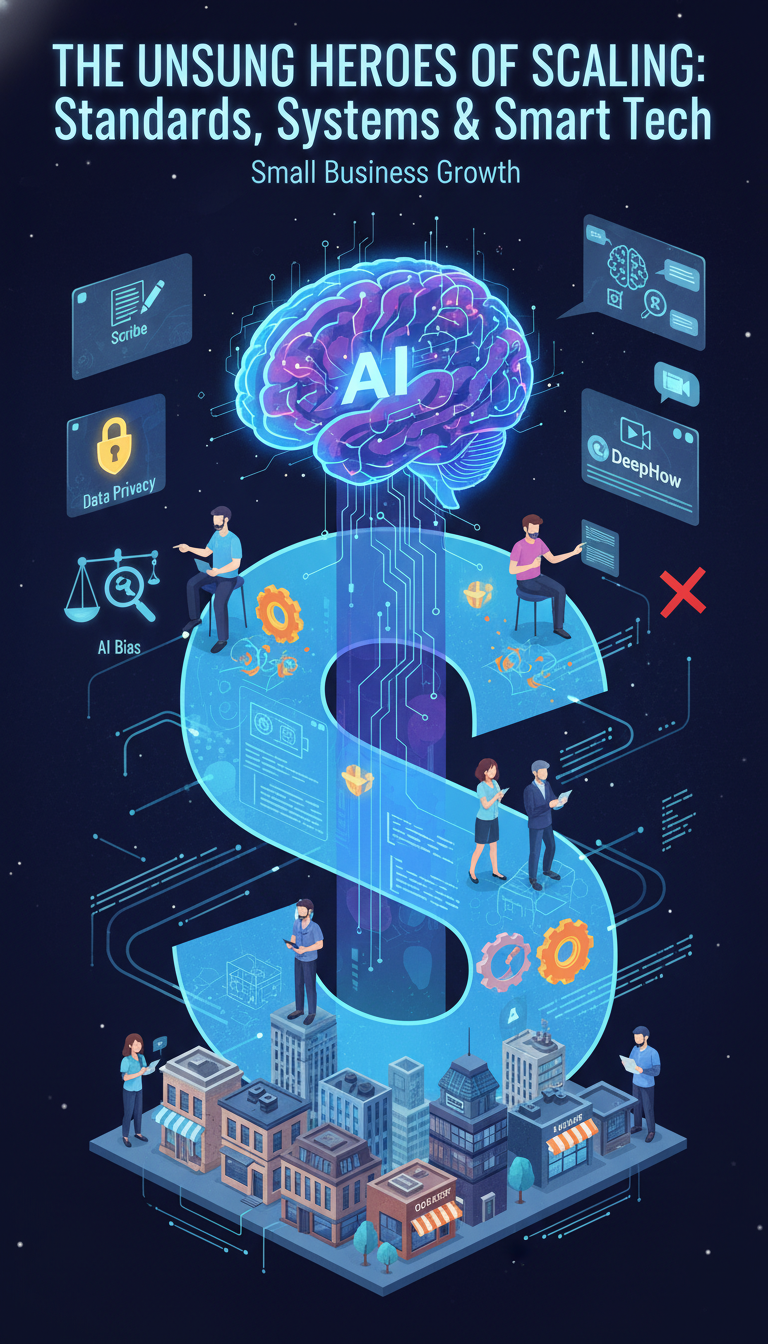
We'll dive into why these foundational elements are still king in an era of rapid technological advancement, exploring how they've evolved and how modern tools like Scribe, Loom, and DeepHow fit into the picture. It's about enhancing, not replacing, the human element. Prepare to have your assumptions challenged and your path to sustainable growth illuminated.
1. The OG Playbook: Why Consistency and Repeatability Reign Supreme
So, what are standards and systems thinking in the context of a small business? It's about recognizing that your business is not a collection of isolated tasks, but rather an interconnected network of processes. It's about creating clear, consistent steps for completing tasks, regardless of who's performing them. Imagine a symphony orchestra where each musician, though brilliant individually, plays from the same score, guided by the same conductor. That's the power of standards and systems.
This isn't about stifling creativity. Far from it! It's about creating a stable and predictable launchpad from which innovation can truly take flight. These foundations drive efficiency, reduce errors, save costs, and build unshakeable customer trust. Think about it: consistent customer support experiences, seamless inventory management, predictable product quality. These are the hallmarks of a business built to last, a business that can scale without sacrificing its core values.
And make no mistake, this is not a new idea. Standardization has been the silent engine of progress for millennia. From ancient weights and measures that facilitated trade to Eli Whitney's interchangeable parts, which revolutionized manufacturing, and Henry Ford's assembly line, which democratized the automobile, standardization has always fueled progress. The birth of formal bodies like the British Standards Institution in 1901 and the International Organization for Standardization (ISO) in 1947 solidified its global importance, underscoring the universal need for consistency and quality.
2. Enter the Robots (and AI): New Tools, Same Core Principles
Now, let's talk about the elephant in the room: AI. The AI and automation revolution is here, and it's supercharging consistency and repeatability for businesses of all sizes, not just the corporate behemoths. The democratization of sophisticated capabilities is upon us. We're talking about potential time savings of 30% on routine tasks, productivity boosts ranging from 40% to 70%, and the possibility of providing 24/7 customer service, all without burning out your team.
The landscape is shifting, with tools emerging that specifically address the challenges of documentation and training. Consider Scribe, which auto-magically turns clicks into step-by-step guides. Imagine onboarding a new employee in half the time, armed with crystal-clear, visually engaging instructions. Then there's Loom, which allows you to explain complex processes with personalized video messages, complete with AI-generated summaries. It's the digital embodiment of "show, don't just tell," and it's incredibly efficient. And for those in the skilled trades, DeepHow captures expert knowledge from video to create searchable, multilingual training modules. No more lost wisdom when a veteran employee retires; their knowledge lives on, accessible to the entire team.
But the applications extend far beyond just documentation. AI is enhancing decision-making, personalizing marketing efforts, and providing increasingly accurate predictive analytics, allowing small businesses to anticipate trends and make proactive adjustments.
3. The Human Element: Why Your Team (and a Sheet of Paper) Still Matter
But before we get too carried away with the shiny allure of AI, let's ground ourselves in a fundamental truth: technology is only as good as the people who use it. And sometimes, the best tools are the simplest ones.
Before you dive headfirst into fancy software, start with a sheet of paper and a pencil. Sketching out processes by hand can be surprisingly effective for initial brainstorming and problem-solving. The act of handwriting can actually boost information processing and understanding, forcing you to think critically about each step.
And more importantly, encourage curiosity within your team. Empower your employees to question existing processes, identify pain points, and suggest improvements. They're on the front lines; they know what works and what doesn't. This fosters a culture of continuous learning and innovation, where everyone feels invested in the success of the business. The vital role of frontline employees in process mapping and digital transformation cannot be overstated. Engaging them, empowering them with tools, and actively listening to their insights is absolutely key to successful scaling.
4. Navigating the AI Minefield: Current Opinions and Controversies
The consensus is clear: AI is rapidly becoming a competitive imperative, not a luxury, for small and medium-sized businesses. Most are already experimenting with or actively using AI in some form. The potential upside is immense – a more level playing field, significant revenue increases, and improved profit margins.
However, we must also acknowledge the potential downsides and controversies. The AI landscape is fraught with ethical considerations that demand careful attention. Data privacy and security are paramount. Who owns your data when using third-party AI tools? How safe is it? Are you inadvertently stumbling into a GDPR or CCPA nightmare?
AI bias and fairness are also critical concerns. AI learns from data, and if that data is biased, the AI will inevitably perpetuate those biases. This can have serious consequences in areas like hiring and lending. Transparency and explainability are also essential. Can you truly trust what an AI tells you if you don't understand how it arrived at that conclusion?
And then there's the very real fear of job displacement. How do you address employee anxiety about robots taking over their jobs? Cybersecurity risks are also amplified in an AI-driven world. AI can be a weapon for bad actors, making small businesses even more vulnerable to attack. Finally, questions of intellectual property infringement loom large. Who owns AI-generated content? The legal landscape is still evolving, creating significant uncertainty.
For SMBs, the challenges are particularly acute. Cost, lack of internal expertise, poor data quality, integration with legacy systems, and simply keeping up with the rapid pace of AI evolution are all significant hurdles. And perhaps the most dangerous pitfall of all is the risk of "automating chaos" – standardizing a bad process, only to amplify its inefficiencies.
5. Looking Ahead: The Future of Standards, AI, and Your Small Business
The future is hurtling toward us at an ever-accelerating pace. Prepare for even more sophisticated AI capabilities in the years to come. "Agentic AI," systems that can design their own workflows, is on the horizon. We'll see the rise of cognitive automation, hyperautomation, and the convergence of AI with other transformative technologies like quantum computing, 5G, and the Internet of Things (IoT). Expect hyper-personalization to reach new levels, and predictive analytics to become even more accurate and insightful.
The role of standards will also continue to evolve. There's an urgent need for robust regulatory frameworks for ethical AI governance. Organizations like the IEEE and ASTM are already developing standards for verifying AI models, ensuring cybersecurity, and promoting transparency. The challenge will be keeping these standards adaptable and relevant in the face of rapid technological change.
Conclusion
In conclusion, standards, systems thinking, and repeatable processes remain the bedrock of sustainable small business growth. AI and automation are powerful accelerants, but they are not a replacement for solid foundations. The most successful small businesses will be those that combine foundational, human-centric approaches – curiosity, engagement, even a humble sheet of paper – with a smart, strategic adoption of AI tools.
Don't simply chase the latest tech trends. Start by understanding your processes, talk to your people, document what you do, and then explore how AI can help you scale intelligently and sustainably. Build a business that is not only efficient and profitable but also resilient, adaptable, and deeply human. The future of small business depends on it.
